Team Restructuring Total Derangement Scenario
Optimize your esports roster restructuring using the mathematics of derangements. This guide explains how to break losing streaks by guaranteeing no player retains their previous role while respecting strict positional constraints. Master complex permutations to prevent cliques, build new skills, and revitalize professional lineups.
Table of Contents
Problem Introduction
An esports organization has N professional players under contract. The team has been underperforming. Morale is low. The coach decides on a radical solution: completely restructure the roster. Every player will be reassigned to a different position or role. No player will remain in their current position.
But there is a catch. In esports, positions are specialized. A support player cannot suddenly become the carry. A tank player cannot become the healer. The restructuring must be a derangement—a permutation with no fixed points—but also respect positional constraints.
For a small team of 5 players, there are 44 ways to completely restructure the roster. For a large esports organization with 20 players across multiple games, the number of possible restructurings has over 18 digits.
This is not just a theoretical exercise. Esports teams, traditional sports teams, and even military units use total derangement restructuring to break losing streaks, prevent cliques, and force players to develop new skills.
Looking to master dynamic programming for sports analytics? Check out our Tutoring Page for personalized 1-on-1 coaching
Why It Matters
Team restructuring using derangements is critical for:
Esports roster management: When a team is stuck in a losing pattern, total restructuring forces players out of their comfort zones and breaks entrenched strategies.
Traditional sports rotation: Basketball coaches rotate lineups, soccer managers change formations, and baseball teams shuffle batting orders. Derangements ensure no player stays in the same position.
Military unit reorganization: After a failed mission, units are sometimes completely restructured to break cliques and prevent groupthink.
Game theory and team dynamics: Understanding derangements helps model how team performance changes under different roster configurations.
Unlike the Secret Santa or job reassignment problems, team restructuring has a performance optimization dimension. Not all derangements are equal. Some derangements (e.g., small 2-cycles) might be less disruptive than large cycles. Coaches may want to maximize "disruption" by preferring derangements with only long cycles.
Step-by-Step Breakdown
Step 1: Understanding the Roster Constraint
Let P₁, P₂, ..., Pₙ be the players, and R₁, R₂, ..., Rₙ be their current positions. A roster restructuring is a function f such that:
f is a permutation (each player gets exactly one position, each position goes to exactly one player)
f(Pᵢ) ≠ Rᵢ for all i (no player keeps their current position)
This is a derangement of N players. However, in esports, not all derangements are feasible due to positional skill requirements. A support player might not have the mechanical skills to play carry. So we often work with constrained derangements where certain assignments are forbidden.
Step 2: Visualizing Esports Roster Restructuring
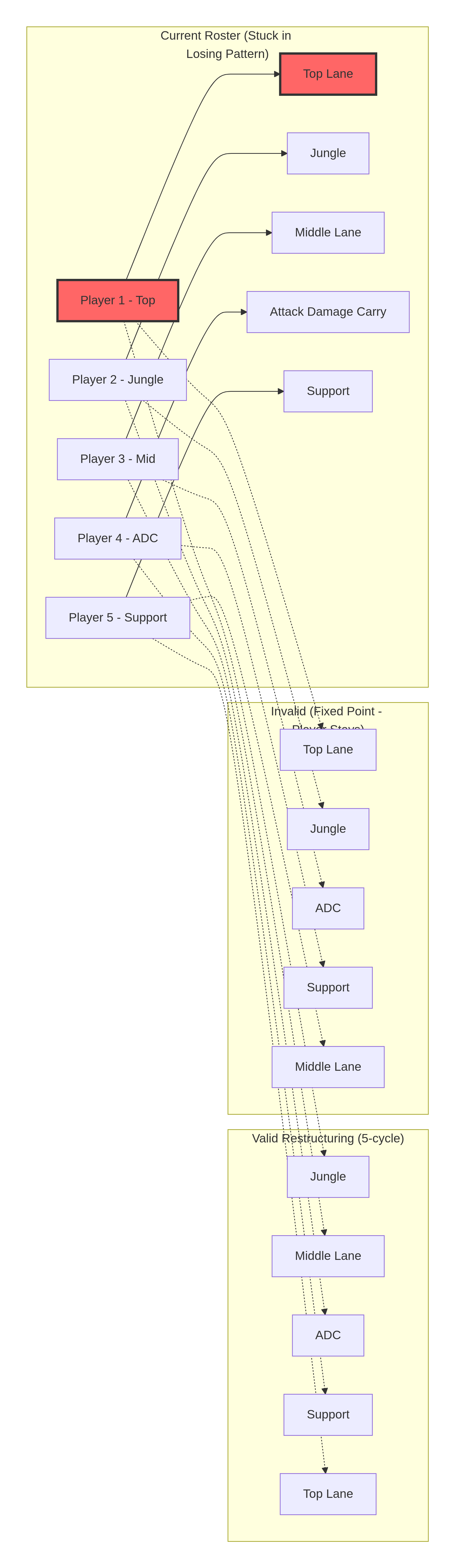
In the valid section, every player moves to a different position in a 5-cycle. Player 1 (Top) becomes Jungle. Player 2 (Jungle) becomes Mid. This forces everyone to learn new skills.
In the invalid section, Player 1 stays in Top Lane (a fixed point), violating the total restructuring rule.
Step 3: Small Team Analysis
Let T(N) be the number of valid roster restructurings for N players.
N = 1 (single player): The only possible assignment is staying in the same position. Invalid. T(1) = 0. A one-player team cannot restructure.
N = 2 (two players): Valid restructurings:
Player1 ↔ Player2 (swap positions)
That's it.
T(2) = 1.
N = 3 (three players): Valid restructurings:
(P1→P2, P2→P3, P3→P1) — a 3-cycle
(P1→P3, P3→P2, P2→P1) — the reverse 3-cycle
T(3) = 2.
N = 4: T(4) = 9. These include 4-cycles (6 of them) and two 2-cycles (3 of them).
N = 5: T(5) = 44.
Step 4: Deriving the Recurrence Relation (Esports Edition)
Let T(N) be the number of valid roster restructurings for N players.
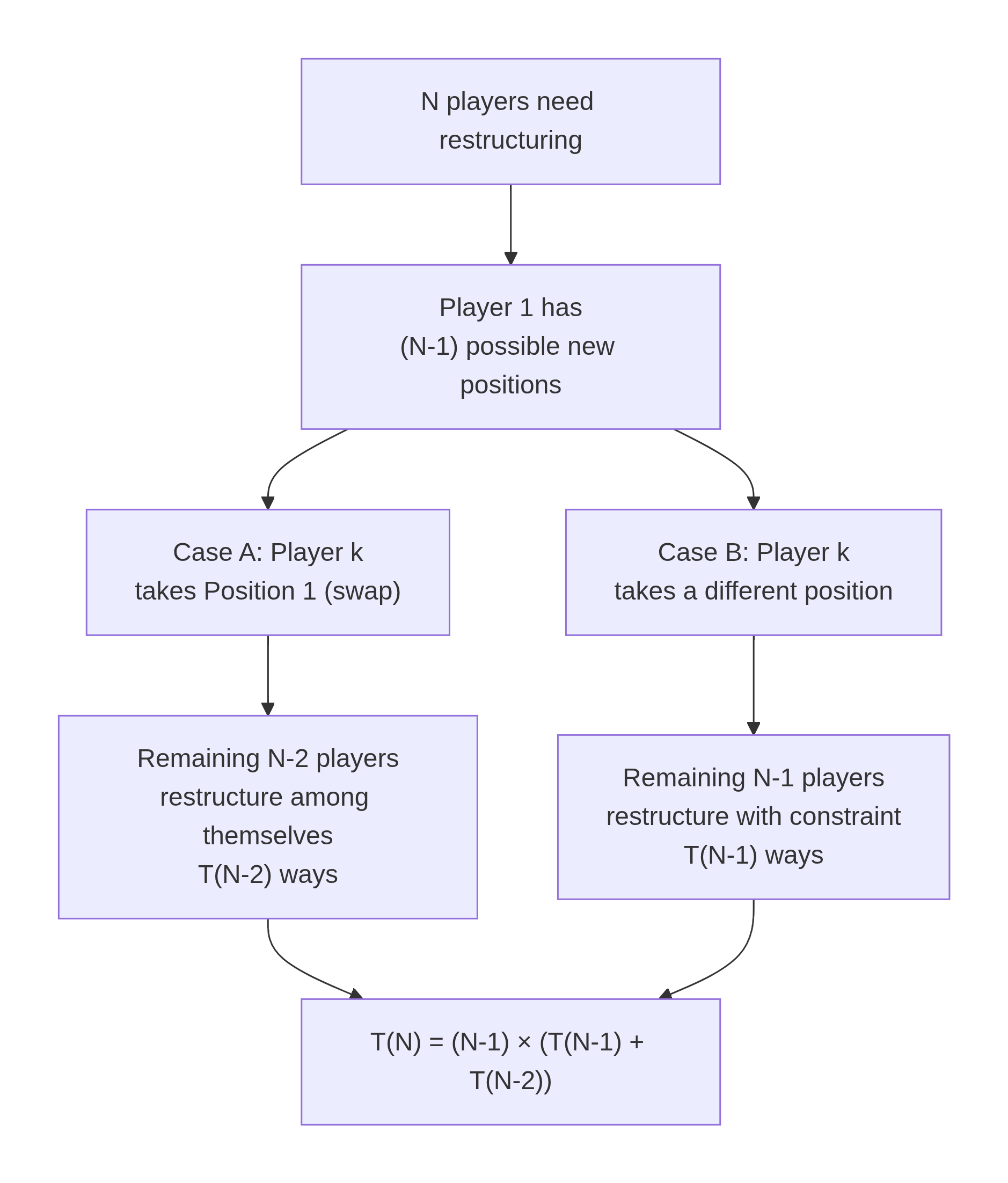
Step A: Where does Player 1 go? Player 1 cannot stay in their current position. So they move to Position k, where k ∈ {2, 3, ..., N}. That's (N - 1) possibilities.
Step B: Analyze Player k's new position.
Now consider Player k (the player who currently holds Position k). Two scenarios:
Scenario 1: Player k moves to Position 1 (a swap)
Player1 → Positionk, Playerk → Position1
These two players have swapped positions
The remaining (N - 2) players must form a valid restructuring among themselves
Number of ways:
T(N - 2)
Scenario 2: Player k moves to a different position (not Position 1)
Player1 → Positionk
Player k cannot move to Position1 (by this scenario) and also cannot stay in Positionk
This is equivalent to finding a valid restructuring for the remaining (N - 1) players, with Position1 now "forbidden" for Player k
Number of ways:
T(N - 1)
Step C: Combine
For each of the (N - 1) choices for Player1's new position:
T(N) = (N - 1) × [T(N - 1) + T(N - 2)]Base cases: T(1) = 0, T(2) = 1.
Step 5: Visualizing Roster Restructuring Options
Step 6: Partial Derangements (Advanced Extension)
In some cases, a coach might want exactly K players to stay in their positions (partial restructuring), not zero. This is called a partial derangement or "rencontres numbers."
Let D(N, K) be the number of permutations of N items where exactly K items are fixed points (stay in place).
Formula: D(N, K) = C(N, K) × !(N - K)
Where C(N, K) is the binomial coefficient (choose which K players stay), and !(N - K) is the number of derangements of the remaining players.
For example, in a 5-player team, if the coach wants exactly 2 players to keep their positions:
Choose which 2 players stay: C(5,2) = 10 ways
Derange the remaining 3 players: !3 = 2 ways
Total: 10 × 2 = 20 partial restructurings
Python
from math import comb

def partial_derangement(n: int, k: int) -> int:
    """
    Number of permutations of n items with exactly k fixed points.

    Args:
        n: Total number of items
        k: Number of items that must stay in place (fixed points)

    Returns:
        Number of permutations with exactly k fixed points
    """
    if k > n:
        return 0

    # Choose which k items stay fixed
    choose_k = comb(n, k)

    # Derange the remaining n-k items
    def derangement(m):
        if m == 0:
            return 1  # Empty set has 1 derangement (the empty permutation)
        if m == 1:
            return 0
        if m == 2:
            return 1
        prev2, prev1 = 0, 1
        for i in range(3, m + 1):
            current = (i - 1) * (prev1 + prev2)
            prev2, prev1 = prev1, current
        return prev1

    return choose_k * derangement(n - k)

# Example for esports team
print("Partial Restructuring Options for 5 Players:")
for k in range(0, 6):
    options = partial_derangement(5, k)
    print(f"  Exactly {k} players stay: {options} restructurings")
Output:
Plain Text
Exactly 0 players stay: 44 restructurings (total derangement)
Exactly 1 player stays: 45 restructurings
Exactly 2 players stay: 20 restructurings
Exactly 3 players stay: 10 restructurings
Exactly 4 players stay: 0 restructurings (impossible)
Exactly 5 players stay: 1 restructuring (everyone stays)
Ready to optimize your esports team restructuring?
Visit our Order Page now to grab our exclusive Dynamic Programming bootcamp courses!
Step 7: Naive Recursive Implementation (Small Team Analysis)
Python
def team_restructuring_recursive(players: int) -> int:
    """
    Naive recursive solution for team restructuring.

    Time: O(2^N) - Exponential, only usable for N <= 30
    Space: O(N) - Recursion stack depth

    Useful for analyzing small esports teams (e.g., 5v5 games like League of Legends).
    """
    if players == 1:
        return 0
    if players == 2:
        return 1

    return (players - 1) * (
        team_restructuring_recursive(players - 1) +
        team_restructuring_recursive(players - 2)
    )

# Analyze team sizes in popular esports
esports_team_sizes = {
    "League of Legends": 5,
    "Dota 2": 5,
    "Counter-Strike 2": 5,
    "Valorant": 5,
    "Overwatch": 6,
    "Rainbow Six Siege": 5,
    "Rocket League": 3
}

print("Esports Team Restructuring Options:")
for game, size in esports_team_sizes.items():
    restructurings = team_restructuring_recursive(size)
    print(f"  {game}: {size} players → {restructurings:,} valid restructurings")
Step 8: Top-Down DP with Memoization (Esports Organization)
Python
def team_restructuring_top_down(players: int, memo: dict = None) -> int:
    """
    Top-down dynamic programming with memoization.

    Time: O(N) - Each N computed once
    Space: O(N) - Memo dictionary + recursion stack

    Suitable for esports organizations managing multiple teams.
    """
    if memo is None:
        memo = {}

    if players == 1:
        return 0
    if players == 2:
        return 1
    if players in memo:
        return memo[players]

    memo[players] = (players - 1) * (
        team_restructuring_top_down(players - 1, memo) +
        team_restructuring_top_down(players - 2, memo)
    )
    return memo[players]

# Large esports organization with academy team
main_team = 5
academy_team = 5
total_restructurings = team_restructuring_top_down(main_team) * team_restructuring_top_down(academy_team)
print(f"Main team restructurings: {team_restructuring_top_down(5):,}")
print(f"Academy team restructurings: {team_restructuring_top_down(5):,}")
print(f"Combined independent restructurings: {total_restructurings:,}")
Step 9: Bottom-Up DP with Tabulation (Team Analytics Dashboard)
Python
def team_restructuring_bottom_up(players: int) -> int:
    """
    Bottom-up dynamic programming using tabulation.

    Time: O(N)
    Space: O(N) - Full DP array

    Useful for analytics dashboards that display restructuring
    options for all team sizes up to N.
    """
    if players == 1:
        return 0
    if players == 2:
        return 1

    # dp[i] = number of valid restructurings for i players
    dp = [0] * (players + 1)
    dp[1] = 0
    dp[2] = 1

    for i in range(3, players + 1):
        dp[i] = (i - 1) * (dp[i - 1] + dp[i - 2])

    return dp[players]

# Team analytics report
print("Team Restructuring Analytics Report")
print("-" * 60)
print("Team Size\tRestructurings\t\tRestructurings per Player")
for size in [3, 4, 5, 6, 7, 8, 9, 10]:
    restructurings = team_restructuring_bottom_up(size)
    per_player = restructurings / size
    print(f"{size}\t\t{restructurings:>15,}\t{per_player:>15,.2f}")
Step 10: Space-Optimized Solution (Mobile Coaching App)
Python
def team_restructuring_optimized(players: int) -> int:
    """
    Space-optimized bottom-up solution.

    Time: O(N)
    Space: O(1) - Only two variables

    Ideal for mobile coaching apps or embedded devices
    with limited memory.
    """
    if players == 1:
        return 0
    if players == 2:
        return 1

    # prev2 = T(i-2), prev1 = T(i-1)
    prev2 = 0  # T(1)
    prev1 = 1  # T(2)

    for i in range(3, players + 1):
        current = (i - 1) * (prev1 + prev2)
        prev2 = prev1
        prev1 = current

    return prev1

# Generate a random valid roster restructuring
def random_roster_restructuring(players: list) -> dict:
    """
    Generate a random valid roster restructuring.

    Args:
        players: List of player names or IDs

    Returns:
        Dictionary mapping player -> new position (original position of another player)
    """
    import secrets
    n = len(players)

    if n == 1:
        raise ValueError("Cannot restructure a single-player team")
    if n == 2:
        return {players[0]: players[1], players[1]: players[0]}

    while True:
        # Generate random permutation using Fisher-Yates with cryptographic randomness
        perm = list(range(n))
        for i in range(n - 1, 0, -1):
            j = secrets.randbelow(i + 1)
            perm[i], perm[j] = perm[j], perm[i]

        # Check for fixed points (players staying in position)
        if all(perm[i] != i for i in range(n)):
            return {players[i]: players[perm[i]] for i in range(n)}

# Example for an esports team
team = ["Faker (Mid)", "Canyon (Jungle)", "Zeus (Top)", "Gumayusi (ADC)", "Keria (Support)"]
restructuring = random_roster_restructuring(team)
print("New Roster Restructuring:")
for player, new_position_holder in restructuring.items():
    print(f"  {player} → {new_position_holder}'s former position")
print(f"\nValid? {all(restructuring[p] != p for p in team)}")
Step 11: Measuring Restructuring Disruption (Cycle Length Analysis)
Not all derangements are equally disruptive. A restructuring composed of many 2-cycles (swaps) is less disruptive than a single N-cycle.
Coaches may want to maximize disruption by preferring derangements with only long cycles.
Python
def cycle_decomposition(perm: list) -> list:
    """Find all cycles in a permutation."""
    n = len(perm)
    visited = [False] * n
    cycles = []

    for i in range(n):
        if not visited[i]:
            cycle = []
            j = i
            while not visited[j]:
                visited[j] = True
                cycle.append(j)
                j = perm[j]
            cycles.append(cycle)

    return cycles

def disruption_score(perm: list) -> float:
    """
    Calculate a disruption score for a restructuring.
    Higher score = more disruptive (preferred for breaking losing streaks).

    Disruption score = average cycle length / maximum possible cycle length
    """
    cycles = cycle_decomposition(perm)
    if not cycles:
        return 0

    avg_cycle_length = sum(len(c) for c in cycles) / len(cycles)
    max_possible = len(perm)
    return avg_cycle_length / max_possible

# Compare different restructurings for a 6-player team
# A single 6-cycle
six_cycle = [1, 2, 3, 4, 5, 0]  # 0→1→2→3→4→5→0
# Three 2-cycles
three_swaps = [1, 0, 3, 2, 5, 4]  # (0↔1), (2↔3), (4↔5)

print("Disruption Analysis for 6-Player Team:")
print(f"  6-cycle disruption score: {disruption_score(six_cycle):.3f}")
print(f"  3 swaps disruption score: {disruption_score(three_swaps):.3f}")
Common Mistakes (Esports & Sports Edition)
Mistake 1: Assuming All Derangements Are Equally Good for Team Performance
A team that swaps players in 2-cycles (Player A↔Player B) might see minimal performance change because only two roles change. A team that uses a full N-cycle forces every player to learn a new role—much more disruptive. Coaches should choose derangements based on desired disruption level.
Mistake 2: Forgetting Positional Constraints
Not every player can play every position. In esports, a support player cannot suddenly become the carry. The pure derangement count overcounts feasible restructurings.
You need constrained derangements that respect skill requirements.
Mistake 3: Ignoring Team Chemistry
Some players have strong synergy. Breaking those pairs might harm performance even if the restructuring is mathematically valid. Coaches must balance mathematical derangements with human factors.
Mistake 4: Restructuring Too Frequently
Total restructuring is disruptive. Doing it every week prevents players from developing role mastery. Most teams restructure once per season or after a major losing streak.
Mistake 5: Not Handling the N=1 Edge Case
A single-player team (e.g., a fighting game competitor) cannot restructure. The only option is to coach the player differently or bring in a substitute.
Frequently Asked Questions
Q1: How does team restructuring differ from the Secret Santa problem?
A: Mathematically identical, but the performance context is different. Secret Santa aims for fairness and unpredictability. Team restructuring aims to maximize performance improvement. Some derangements are better than others (long cycles are more disruptive), while in Secret Santa, all derangements are equally valid.
Q2: What is a partial derangement, and when would a coach use it?
A: A partial derangement has exactly K players staying in their positions. A coach might use this when certain players are irreplaceable in their roles (e.g., a star quarterback) but everyone else should rotate. For N=11 (soccer), the coach might keep the goalkeeper fixed (K=1) and derange the other 10 players.
Q3: Can this be used for traditional sports like basketball?
A: Yes. Basketball coaches frequently rotate lineups. A derangement ensures no player stays in the same position. For a 5-player basketball team, there are 44 ways to restructure positions (point guard, shooting guard, small forward, power forward, center).
Q4: What is the time complexity of generating a random valid restructuring?
A: Using rejection sampling, O(N) expected time with ~2.718 trials on average. This is efficient enough for real-time coaching apps.
Q5: How do I extend this to constrained derangements (skill requirements)?
A: Constrained derangements where certain assignments are forbidden require the permanent of a (0,1)-matrix (Ryser's formula), which is #P-complete. For small N (≤ 20), use inclusion-exclusion. For larger N, use Monte Carlo sampling.
Conclusion
Team restructuring using total derangement is a powerful tool for esports organizations and sports teams looking to break losing streaks and force player development. You have learned:
How to model roster restructuring as a permutation with no fixed points
Why T(N) grows super-exponentially, providing a massive configuration space
How to implement the recurrence in four ways, from naive recursion to O(1) space optimization
How to extend to partial derangements where exactly K players stay
How to measure restructuring disruption using cycle length analysis
Common coaching mistakes (ignoring positional constraints, restructuring too frequently)
The next time your favorite esports team announces a roster shakeup, you will understand the mathematics behind it. And if you are coaching a team, you now have the tools to restructure effectively.
Ready to optimize your esports team restructuring?
Want to master Advanced Dynamic Programming for sports analytics? Our platform has everything you need.
👉 Visit Our Tutoring Page to book a session today.
👉 Check Our Order Page for direct access to our full DP coursework!
Where to Go Next
If you found this guide helpful, you might also enjoy these related resources:
Return to the anchor article: Counting Derangements: Main Guide – For a complete overview of derangement theory, including the full recurrence derivation, base cases, and a comparison of all four DP approaches (recursive, top-down, bottom-up, optimized).
Optimizing Job Reassignments without Overlap – Learn how the same derangement logic applies to HR compliance, banking regulations, and fraud prevention.
General Gift Exchange Combinatorics – Discover how derangements model department-level gift exchanges and supply chain inter-trading.
Esports Roster Optimization – Read our blog post on using combinatorial algorithms for competitive gaming.
Partial Derangements in Sports Analytics – Explore advanced techniques for constrained team restructuring.
Related Posts
How to Approach Hard LeetCode Problems | A Strategic Framework
Master the mental framework and strategies to confidently break down and solve even the most challenging LeetCode problems.
Mar 06, 2026Counting Derangements: A Comprehensive Guide to Solving Derangements
Unlock the mathematical complexity behind disorganized sets with this comprehensive guide to derangements. This deep dive moves beyond simple counting, …
Apr 18, 2026Binary Search Explained: Algorithm, Examples, & Edge Cases
Master the binary search algorithm with clear, step-by-step examples. Learn how to implement efficient searches in sorted arrays, avoid common …
Mar 11, 2026Need Coding Help?
Get expert assistance with your programming assignments and projects.