Solving the Secret Santa Problem with Dynamic Programming
Planning a Secret Santa? Skip the frustrating redraws using the mathematics of derangements. This guide reveals how computer science guarantees a flawless, self-loop-free gift exchange. We explore the 37% failure rate of random draws and super-exponential scaling. Master constrained permutations and automate your holiday event with our Python implementations and dynamic programming strategies.
Table of Contents
Problem Introduction
The office holiday party is approaching. Someone suggests a Secret Santa gift exchange. Names go into a hat. Everyone draws one name.
The only rule that makes it interesting? No one can draw their own name.
You are put in charge of the drawing. You could just have everyone pick a slip of paper randomly. But there is a problem: with random drawing, there is a significant chance that someone will draw their own name—and then everyone has to start over. For a group of 10 people, that happens about 37% of the time.
But here is a deeper question that few people ask: How many valid Secret Santa assignments actually exist?
For a group of 4 people, the answer is 9. For 5 people, it is 44. For 10 people, it is over 1.3 million. For 20 people, it is roughly 895 quadrillion—more than the number of grains of sand on every beach on Earth.
This is the Secret Santa problem, and it is mathematically identical to counting derangements: permutations of N items where no item appears in its original position. Understanding how to count these arrangements efficiently is a gateway to mastering dynamic programming.
Why It Matters
The Secret Santa problem is far more than a party game. It teaches:
Randomized algorithm validation: When building a digital Secret Santa tool, how do you verify it produces truly random, valid assignments? The answer requires understanding derangements.
Probability theory in practice: The probability that a random permutation is a derangement converges to 1/e ≈ 36.79%. This constant appears throughout mathematics and computer science.
Technical interview preparation: FAANG companies frequently ask derangement-based questions to test DP reasoning and combinatorial thinking.
Fairness in randomized systems: Any system that randomly assigns items to people without self-matching (e.g., random roommate pairing, task assignment) relies on derangement logic.
Unlike the job reassignment or key-lock problems, Secret Santa is the most accessible introduction to derangements. It uses familiar, low-stakes language (gifts, friends, holiday parties) to introduce a deep combinatorial concept. Once you understand Secret Santa, you can apply the same logic to banking compliance, network routing, and cryptography.
Step-by-Step Breakdown
Step 1: Restating as a Permutation Problem
Let's label the participants P₁, P₂, ..., Pₙ. A Secret Santa assignment is a function f such that:
f is a permutation (each person gives to exactly one person, each person receives from exactly one person)
f(Pᵢ) ≠ Pᵢ for all i (no one gives to themselves)
This is a derangement of N items. The number of such assignments is !N (subfactorial N).
Step 2: Visualizing Valid vs. Invalid Assignments

In the valid section, we see a 3-cycle (Alice→Bob→Charlie→Alice) and a pair of 2-cycles (Diana↔Eve and Frank↔Grace). No one gives to themselves.
In the invalid section, Ian gives to himself (a fixed point). This breaks the Secret Santa rule.
Step 3: Small Group Analysis
Let's manually compute for small groups to build intuition.
N = 2 (Alice and Bob):
Valid: Alice→Bob, Bob→Alice (swap)
Invalid: Alice→Alice, Bob→Bob (both self-gift)
Count: 1 valid assignment
N = 3 (Alice, Bob, Charlie):
All 6 permutations:
| Permutation | Self-gifts? | Valid? |
|---|---|---|
| A→A, B→B, C→C | A,B,C | No |
| A→A, B→C, C→B | A | No |
| A→B, B→A, C→C | C | No |
| A→B, B→C, C→A | None | Yes |
| A→C, B→A, C→B | None | Yes |
| A→C, B→B, C→A | B | No |
Count: 2 valid assignments
N = 4: Without listing all 24 permutations, the count is 9.
N = 5: 44 valid assignments.
Step 4: Deriving the Recurrence Relation
Let S(N) be the number of valid Secret Santa assignments for N people.
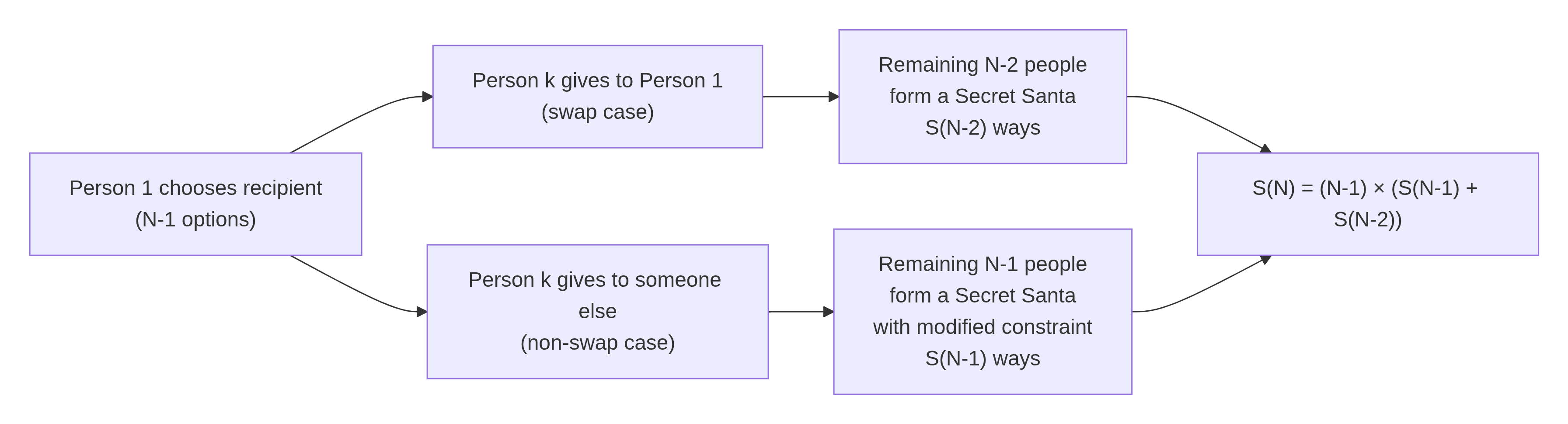
Step A: Who does Person 1 give to? Person 1 cannot give to themselves. So they give to Person k, where k ∈ {2, 3, ..., N}. That is (N - 1) possibilities.
Step B: Analyze who Person k gives to.
Now consider Person k (the person who received Person 1's gift). Two scenarios:
Scenario 1: Person k gives to Person 1 (a swap)
Person1 → Personk, Personk → Person1
These two have exchanged gifts
The remaining (N - 2) people must form a valid Secret Santa among themselves
Number of ways:
S(N - 2)
Scenario 2: Person k gives to someone else (not Person 1)
Person1 → Personk
Person k cannot give to Person1 (by this scenario) and also cannot give to themselves
This is equivalent to finding a valid Secret Santa for the remaining (N - 1) people, with Person1 now "forbidden" as a recipient for Personk
Number of ways:
S(N - 1)
Step C: Combine
For each of the (N - 1) choices for Person1's recipient:
Plain Text
S(N) = (N - 1) × [S(N - 1) + S(N - 2)]Base cases: S(1) = 0, S(2) = 1.
Let's verify: S(3) = 2 × (S(2) + S(1)) = 2 × (1 + 0) = 2 ✓
S(4) = 3 × (S(3) + S(2)) = 3 × (2 + 1) = 9 ✓
Step 5: Visualizing the Recurrence for Secret Santa
Step 6: Naive Recursive Implementation
Python
def secret_santa_recursive(n: int) -> int:
    """
    Naive recursive solution for Secret Santa assignments.

    Time: O(2^N) - Exponential, only usable for N <= 30
    Space: O(N) - Recursion stack depth

    This directly implements S(N) = (N-1) * (S(N-1) + S(N-2)).
    """
    if n == 1:
        return 0  # One person cannot avoid self-gift
    if n == 2:
        return 1  # Only a swap

    return (n - 1) * (secret_santa_recursive(n - 1) +
                      secret_santa_recursive(n - 2))

# Calculate for common group sizes
print("Secret Santa Valid Assignments:")
for n in [2, 3, 4, 5, 6, 7, 8, 9, 10]:
    assignments = secret_santa_recursive(n)
    print(f"  {n} people: {assignments:,} valid assignments")
Output:
Plain Text
2 people: 1 valid assignments
3 people: 2 valid assignments
4 people: 9 valid assignments
5 people: 44 valid assignments
6 people: 265 valid assignments
7 people: 1,854 valid assignments
8 people: 14,833 valid assignments
9 people: 133,496 valid assignments
10 people: 1,334,961 valid assignments
The problem: For N=30, this function would make over a billion recursive calls. Your computer would take hours to compute what a DP solution does in milliseconds.
Ready to build your own Secret Santa generator?
Visit our Order Page now to grab our exclusive Dynamic Programming bootcamp courses!
Step 7: Top-Down DP with Memoization
Python
def secret_santa_top_down(n: int, memo: dict = None) -> int:
    """
    Top-down dynamic programming with memoization.

    Time: O(N) - Each N computed once
    Space: O(N) - Memo dictionary + recursion stack

    This is efficient for any N up to about 10^5 (Python recursion limit).
    """
    if memo is None:
        memo = {}

    if n == 1:
        return 0
    if n == 2:
        return 1
    if n in memo:
        return memo[n]

    memo[n] = (n - 1) * (secret_santa_top_down(n - 1, memo) +
                         secret_santa_top_down(n - 2, memo))
    return memo[n]

# Example for a large office party
office_size = 25
assignments = secret_santa_top_down(office_size)
print(f"For {office_size} people: {assignments:,} valid Secret Santa assignments")
print(f"Number of digits: {len(str(assignments))}")
Insight: For a 25-person office, the number of valid Secret Santa assignments has 25 digits. That is more than the number of seconds since the Big Bang.
Step 8: Bottom-Up DP with Tabulation
Python
def secret_santa_bottom_up(n: int) -> int:
    """
    Bottom-up dynamic programming using tabulation.

    Time: O(N)
    Space: O(N) - Full DP array

    This approach is useful when you need all intermediate values
    for analysis (e.g., plotting growth rates).
    """
    if n == 1:
        return 0
    if n == 2:
        return 1

    # dp[i] = number of valid assignments for i people
    dp = [0] * (n + 1)
    dp[1] = 0
    dp[2] = 1

    for i in range(3, n + 1):
        dp[i] = (i - 1) * (dp[i - 1] + dp[i - 2])

    return dp[n]


 # Analyze how quickly the number of assignments grows
print("Growth Analysis of Secret Santa Assignments:")
print("N\tS(N)\t\t\tS(N)/S(N-1)")
print("-" * 50)
prev = 0
for n in range(2, 13):
    current = secret_santa_bottom_up(n)
    if n > 3:
        ratio = current / prev
        print(f"{n}\t{current:>20,}\t{ratio:.2f}")
    else:
        print(f"{n}\t{current:>20,}\t")
    prev = current
Output shows the ratio approaching N (approximately), confirming that S(N) grows faster than exponentially.
Step 9: Space-Optimized Solution (For Web Apps)
Python
def secret_santa_optimized(n: int) -> int:
    """
    Space-optimized bottom-up solution.

    Time: O(N)
    Space: O(1) - Only two variables

    This is ideal for web applications, mobile apps, or any environment
    where memory efficiency matters.
    """
    if n == 1:
        return 0
    if n == 2:
        return 1

    # prev2 = S(i-2), prev1 = S(i-1)
    prev2 = 0  # S(1)
    prev1 = 1  # S(2)

    for i in range(3, n + 1):
        current = (i - 1) * (prev1 + prev2)
        prev2 = prev1
        prev1 = current

    return prev1

# Generate a random valid Secret Santa assignment
def random_secret_santa(participants: list) -> dict:
    """
    Generate a random valid Secret Santa assignment.

    Uses rejection sampling: generate random permutation,
    check if it's a derangement, repeat if not.

    Expected trials: ~2.718
    """
    import secrets
    n = len(participants)

    if n == 1:
        raise ValueError("Cannot run Secret Santa with 1 person")
    if n == 2:
        return {participants[0]: participants[1], participants[1]: participants[0]}

    while True:
        # Generate random permutation using Fisher-Yates with cryptographic randomness
        perm = list(range(n))
        for i in range(n - 1, 0, -1):
            j = secrets.randbelow(i + 1)
            perm[i], perm[j] = perm[j], perm[i]

        # Check for fixed points (no one gives to themselves)
        if all(perm[i] != i for i in range(n)):
            return {participants[i]: participants[perm[i]] for i in range(n)}

# Example office party
office = ["Alice", "Bob", "Charlie", "Diana", "Eve", "Frank"]
assignment = random_secret_santa(office)
print("Secret Santa Assignment:")
for giver, receiver in assignment.items():
    print(f"  {giver} → {receiver}")
print(f"\nValid? {all(assignment[p] != p for p in office)}")
Step 10: Probability of a Random Draw Being Valid
Python
import math

def secret_santa_probability(n: int) -> float:
    """
    Probability that a random permutation is a valid Secret Santa assignment.

    As n grows large, this approaches 1/e ≈ 0.36787944117.
    """
    valid = secret_santa_optimized(n)
    total = math.factorial(n)
    return valid / total

print("Probability that a random draw works:")
print(f"  n=3: {secret_santa_probability(3):.6f}")
print(f"  n=4: {secret_santa_probability(4):.6f}")
print(f"  n=5: {secret_santa_probability(5):.6f}")
print(f"  n=6: {secret_santa_probability(6):.6f}")
print(f"  n=10: {secret_santa_probability(10):.6f}")
print(f"  n=20: {secret_santa_probability(20):.6f}")
print(f"  Limit: {1/math.e:.6f} (1/e)")
Output:
Plain Text
n=3: 0.333333
n=4: 0.375000
n=5: 0.366667
n=6: 0.368056
n=10: 0.367879
n=20: 0.367879
Limit: 0.367879 (1/e)
Practical takeaway: If you randomly draw names, you have about a 37% chance of getting a valid assignment on the first try. That means you will need to redraw about 2.7 times on average.
Common Mistakes
Mistake 1: Assuming All Permutations Are Equally Likely in a Physical Draw
In a physical hat draw, the process does not produce uniformly random permutations. The order of drawing affects probabilities. Always use a digital random number generator for true uniformity.
Mistake 2: Forgetting That S(1) = 0
Some people think a single person can be their own Secret Santa. That defeats the purpose. The problem explicitly forbids self-gifting.
Mistake 3: Using a Simple Cycle as the Only Assignment
Many Secret Santa organizers use a deterministic cycle (Person1→Person2→...→PersonN→Person1). While this is a valid derangement, it is completely predictable. If anyone learns the cycle, they know everyone's assignment.
Always randomize.
Mistake 4: Not Handling the N=2 Edge Case Correctly
For 2 people, the only valid assignment is a swap. Some algorithms incorrectly mark this as "no valid assignments" because they think a 2-cycle creates a loop. In Secret Santa, a swap is perfectly valid.
Mistake 5: Implementing Rejection Sampling Without a Maximum Retry Limit
The expected number of trials is 2.718, but theoretically, you could have an infinite loop if you get unlucky. Always add a maximum retry limit:
Python
def random_secret_santa_with_limit(participants, max_retries=100):
    for _ in range(max_retries):
        # attempt to generate valid assignment
        pass
    raise RuntimeError("Could not generate valid assignment after {max_retries} tries")
Frequently Asked Questions
Q1: How does Secret Santa differ from the hat check problem?
A: They are mathematically identical. The hat check problem asks for the probability that no one gets their own hat. Secret Santa asks for the number of ways no one draws their own name. Both use the same derangement recurrence. The difference is purely in the storytelling.
Q2: What is the expected number of retries when randomly drawing names?
A: Each random permutation has probability ~0.3679 of being a derangement. So the expected number of trials is 1/0.3679 ≈ 2.718. This matches the mathematical constant e.
Q3: Can Secret Santa be done with an odd number of people?
A: Yes. Derangements exist for all N except N=1. For N=3, there are 2 valid assignments. For N=5, there are 44. The only impossible case is a single person.
Q4: How do I verify that a Secret Santa assignment is valid?
A: Check that no one is assigned to themselves. In Python: all(assignment[person] != person for person in assignment)
Q5: What is the time complexity of the optimized Secret Santa algorithm?
A: O(N) time and O(1) space. The single loop from 3 to N performs constant-time operations at each iteration. This is optimal for exact counting.
Conclusion
The Secret Santa problem is the perfect introduction to derangements and dynamic programming. Here's what you have learned:
How to model a party game as a combinatorial counting problem
Why the recurrence
S(N) = (N-1) × (S(N-1) + S(N-2))emerges from swap/no-swap logicHow to implement the recurrence in four ways: naive recursion (exponential), top-down memoization (linear time, linear space), bottom-up tabulation (linear time, linear space), and space-optimized (linear time, constant space)
How to generate random valid assignments using cryptographic randomness
Why the probability of a valid random draw converges to 1/e ≈ 36.79%
The next time your office organizes a Secret Santa, you will know exactly how many valid assignments exist—and how to generate one fairly.
Ready to build your own Secret Santa generator?
Want to master Advanced Dynamic Programming for real-world applications? Our platform has everything you need.
👉 Visit Our Tutoring Page to book a session today.
👉 Check Our Order Page for direct access to our full DP coursework!
Where to Go Next
If you found this guide helpful, you might also enjoy these related resources:
Return to the anchor article: Counting Derangements: Main Guide – For a complete overview of derangement theory, including the full recurrence derivation, base cases, and a comparison of all four DP approaches (recursive, top-down, bottom-up, optimized).
Optimizing Job Reassignments without Overlap – Learn how the same derangement logic applies to HR compliance, banking regulations, and fraud prevention.
Network Node Routing Preventing Immediate Return – Discover how telecom companies use derangements to prevent micro-loops in packet routing.
The Mathematics of Secret Santa – Read our blog post on the history and probability of derangements.
Building a Fair Secret Santa Generator – Explore best practices for cryptographic randomness in gift exchange apps.
Tags:
#derangements #dynamic-programming #gift-exchange-algorithm #permutation-without-fixed-points #Python-DP #Secret SantaRelated Posts
Counting Derangements: A Comprehensive Guide to Solving Derangements
Unlock the mathematical complexity behind disorganized sets with this comprehensive guide to derangements. This deep dive moves beyond simple counting, …
Apr 18, 2026Binary Search Explained: Algorithm, Examples, & Edge Cases
Master the binary search algorithm with clear, step-by-step examples. Learn how to implement efficient searches in sorted arrays, avoid common …
Mar 11, 2026How to Approach Hard LeetCode Problems | A Strategic Framework
Master the mental framework and strategies to confidently break down and solve even the most challenging LeetCode problems.
Mar 06, 2026Need Coding Help?
Get expert assistance with your programming assignments and projects.