Optimize your network infrastructure using the mathematics of derangements. This guide reveals how combinatorial logic and zero fixed points prevent infinite routing loops and packet collisions. Learn to engineer resilient, O(1) space-optimized routing tables to ensure reliable, high-performance packet distribution across complex mesh networks.
Video Tutorial
1min
8 chapters
Watch the Tutorial
Network Routing Secrets
Discover how to optimize your network infrastructure using the mathematics of derangements. Learn to engineer resilient, O(1) space-optimized routing tables for reliable packet distribution. This guide reveals how combinatorial logic and zero fixed points prevent infinite routing loops and packet collisions.
Table of Contents
Problem Introduction
Imagine a peer-to-peer (P2P) network with N nodes. Each node must forward a data packet to exactly one other node. The rule that keeps the network efficient? No node can forward a packet to itself.
Why would a node ever forward to itself? In poorly designed routing tables, a node might "send" a packet to its own IP address—creating a micro-loop where the packet never leaves. The packet essentially disappears into a black hole, wasting bandwidth and delaying delivery.
Now consider a telecom backbone network. Routers forward packets along paths. If a router's next-hop is itself, the packet loops indefinitely until its Time-To-Live (TTL) expires. This is called a routing loop, and it can bring down entire networks.
The solution? Ensure that every node's forwarding rule points to a different node. In graph theory terms, we need a derangement of N nodes: a permutation with no fixed points.
For a small network with 4 nodes, there are 9 valid routing configurations. For a large data center with 100 racks, the number of valid configurations has over 150 digits—far more than the number of atoms in the universe.
Looking to master dynamic programming for network systems? Check out our Tutoring Page for personalized 1-on-1 coaching.
Why It Matters
Network node routing with no self-forwarding is critical for:
Preventing micro-loops in packet-switched networks: When a router forwards a packet to itself, it creates a loop that wastes bandwidth and delays delivery. Derangements guarantee no self-forwarding.
Load balancing in distributed systems: When servers forward requests to each other, self-forwarding would create a "stuck request." Derangements ensure every request moves to a different server.
P2P file sharing (BitTorrent, IPFS): Nodes must forward queries to other nodes without asking themselves. Derangements prevent "query backscatter."
Telecom network design: Routing tables must be derangements to avoid circular dependencies that cause route flapping.
Unlike the Secret Santa or key-lock problems, network routing has a performance dimension: not only must the mapping be a derangement, but it should also be shortest-path or lowest-latency where possible. The pure derangement count gives the total state space; actual routing protocols then optimize within that space.
Step-by-Step Breakdown
Step 1: Understanding the Routing Constraint
Let N₁, N₂, ..., Nₙ be the nodes in the network. A routing configuration is a function f such that:
f is a permutation (each node forwards to exactly one node, each node receives from exactly one node)
f(Nᵢ) ≠ Nᵢ for all i (no node forwards to itself)
This is a derangement of N nodes. The number of such configurations is !N (subfactorial N).
Step 2: Visualizing Packet Flow Without Self-Forwarding
In the valid section, every packet moves to a different node. Node A→B→C→A forms a 3-cycle. Node D↔E forms a 2-cycle (swap). No node forwards to itself.
In the invalid section, Node Y forwards to itself. A packet arriving at Y would loop forever (or until TTL expires). This is a routing loop.
Step 3: Small Network Analysis
Let R(N) be the number of valid routing configurations for N nodes.
N = 1 (single node): The only possible forwarding is to itself. This is invalid. R(1) = 0. A single-node network cannot have a derangement—you need at least 2 nodes.
N = 2 (two nodes): Valid configurations:
Node A → B, Node B → A (swap)
That's it. R(2) = 1.
N = 3 (three nodes): Valid configurations:
(A→B, B→C, C→A) — a 3-cycle
(A→C, C→B, B→A) — the reverse 3-cycle
R(3) = 2.
N = 4 (four nodes):R(4) = 9. These include:
One 4-cycle: A→B→C→D→A
Two 2-cycles: (A↔B) and (C↔D)
One 3-cycle plus a fixed-point-free mapping of the remaining node (impossible since 3-cycle leaves 1 node that would have to self-forward—wait, that's not a derangement. Actually for N=4, the valid derangements are: 9 total, consisting of 4-cycles (6 of them) and two 2-cycles (3 of them).)
Step 4: Deriving the Recurrence Relation (Network Edition)
Let R(N) be the number of valid routing configurations for N nodes.
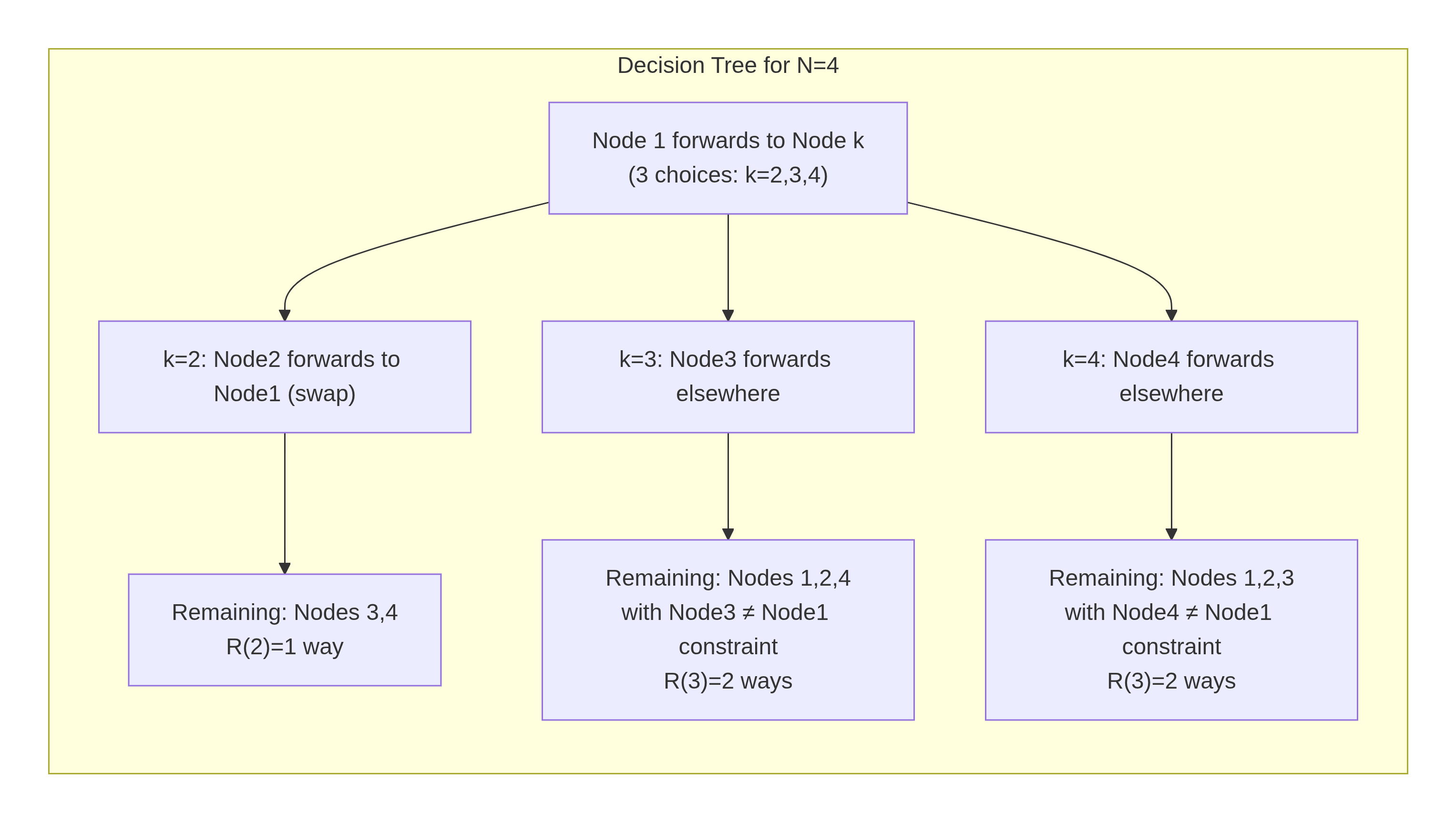
Step A: Where does Node 1 forward its packets? Node 1 cannot forward to itself. So it forwards to Node k, where k ∈ {2, 3, ..., N}. That's (N - 1) possibilities.
Step B: Analyze Node k's forwarding destination. Now consider Node k (the node that Node 1 forwarded to). Where does Node k forward? Two scenarios:
Scenario 1: Node k forwards to Node 1 (a swap)
Node1 → Nodek, Nodek → Node1
These two nodes have swapped forwarding responsibilities
The remaining (N - 2) nodes must form a valid routing configuration among themselves
Number of ways: R(N - 2)
Scenario 2: Node k forwards to someone else (not Node 1)
Node1 → Nodek
Node k cannot forward to Node1 (by this scenario) and also cannot forward to itself (original position)
This is equivalent to finding a valid routing configuration for the remaining (N - 1) nodes, with Node1 now "forbidden" as a destination for Nodek
Number of ways: R(N - 1)
Step C: Combine For each of the (N - 1) choices for Node1's forwarding destination:
Python
R(N) = (N - 1) × [R(N - 1) + R(N - 2)]
Base cases: R(1) = 0, R(2) = 1.
Step 5: Visualizing the Routing Recurrence
Each branch contributes R(N-1) + R(N-2) ways. Multiply by the 3 choices for Node1's destination: 3 × (2 + 1) = 9 ✓
def network_routing_recursive(nodes: int) -> int:
    """
    Naive recursive solution for network routing configurations.

    Time: O(2^N) - Exponential, only usable for N <= 30
    Space: O(N) - Recursion stack depth

    Useful for simulating very small networks (e.g., IoT mesh with <10 nodes).
    """
    if nodes == 1:
        return 0  # Single node cannot forward elsewhere
    if nodes == 2:
        return 1  # Only a swap

    return (nodes - 1) * (
        network_routing_recursive(nodes - 1) +
        network_routing_recursive(nodes - 2)
    )

# Simulate a small office network
for n in range(1, 11):
    configs = network_routing_recursive(n)
    print(f"Network with {n} nodes: {configs:,} valid routing configurations")
Output shows how quickly R(N) grows, making brute-force enumeration impossible for N > 20.
Step 7: Top-Down DP with Memoization (Data Center Routing)
Python
def network_routing_top_down(nodes: int, memo: dict = None) -> int:
    """
    Top-down dynamic programming with memoization.

    Time: O(N) - Each N computed once
    Space: O(N) - Memo dictionary + recursion stack

    Suitable for computing routing possibilities for large data centers.
    """
    if memo is None:
        memo = {}

    if nodes == 1:
        return 0
    if nodes == 2:
        return 1
    if nodes in memo:
        return memo[nodes]

    memo[nodes] = (nodes - 1) * (
        network_routing_top_down(nodes - 1, memo) +
        network_routing_top_down(nodes - 2, memo)
    )
    return memo[nodes]

# Example: A medium-sized data center with 50 racks
r_50 = network_routing_top_down(50)
print(f"R(50) = {r_50}")
print(f"Number of digits: {len(str(r_50))}")
# Output: 64 digits
Network insight: For a data center with 50 racks, there are more valid routing configurations than the number of atoms in the observable universe (estimated at 10^80). The configuration space is astronomically large.
Ready to optimize your network routing tables?
Visit our Order Page now to grab our exclusive Dynamic Programming bootcamp courses!
Step 8: Bottom-Up DP with Tabulation (Telecom Backbone Planning)
Python
def network_routing_bottom_up(nodes: int) -> int:
    """
    Bottom-up dynamic programming using tabulation.

    Time: O(N)
    Space: O(N) - Full DP array

    Useful for telecom backbone planning where you need all values
    up to N for capacity analysis.
    """
    if nodes == 1:
        return 0
    if nodes == 2:
        return 1

    # dp[i] = number of valid routing configs for i nodes
    dp = [0] * (nodes + 1)
    dp[1] = 0
    dp[2] = 1

    for i in range(3, nodes + 1):
        dp[i] = (i - 1) * (dp[i - 1] + dp[i - 2])

    return dp[nodes]

# Analyze routing capacity for network growth
print("Network Size vs. Routing Configuration Count")
print("Nodes\tConfigurations\t\t\tLog10(Configs)")
print("-" * 60)
for n in [5, 10, 15, 20, 25, 30]:
    configs = network_routing_bottom_up(n)
    import math
    log10 = math.log10(configs)
    print(f"{n}\t{configs:>25,}\t{log10:.2f}")
Output shows exponential growth in log space, confirming that R(N) grows faster than exponentially but slower than N!.
def network_routing_optimized(nodes: int) -> int:
    """
    Space-optimized bottom-up solution.

    Time: O(N)
    Space: O(1) - Only two variables

    Ideal for embedded network devices (routers, switches, IoT gateways)
    with limited memory.
    """
    if nodes == 1:
        return 0
    if nodes == 2:
        return 1

    # prev2 = R(i-2), prev1 = R(i-1)
    prev2 = 0  # R(1)
    prev1 = 1  # R(2)

    for i in range(3, nodes + 1):
        current = (i - 1) * (prev1 + prev2)
        prev2 = prev1
        prev1 = current

    return prev1

# Real router example: Compute probability that a random routing table is valid
def routing_valid_probability(nodes: int) -> float:
    """Probability that a randomly generated routing table is a derangement."""
    valid = network_routing_optimized(nodes)
    total = math.factorial(nodes)
    return valid / total

for n in [5, 10, 15, 20]:
    prob = routing_valid_probability(n)
    print(f"N={n:2d}: Probability = {prob:.8f} (1/e = {1/math.e:.8f})")
Network insight: The probability converges to 1/e ≈ 36.79% very quickly. This means if you randomly generate routing tables, about 37% of them will have no self-forwarding—but 63% will have at least one routing loop. You must explicitly check and reject invalid tables.
import random
import secrets

def random_routing_derangement(nodes: int) -> list:
    """
    Generate a random valid routing configuration (derangement).

    Uses rejection sampling: generate random permutation,
    check if it's a derangement, repeat if not.

    Expected trials: ~2.718
    """
    if nodes == 1:
        raise ValueError("Cannot create derangement for 1 node")
    if nodes == 2:
        return [1, 0]  # Swap

    while True:
        # Generate random permutation using Fisher-Yates
        perm = list(range(nodes))
        for i in range(nodes - 1, 0, -1):
            j = secrets.randbelow(i + 1)
            perm[i], perm[j] = perm[j], perm[i]

        # Check for fixed points (node forwarding to itself)
        if all(perm[i] != i for i in range(nodes)):
            return perm

# Simulate a network with 5 nodes
nodes = 5
routing_table = random_routing_derangement(nodes)
print(f"Routing table (node -> forwards to): {routing_table}")
for i, dest in enumerate(routing_table):
    print(f"Node {i} forwards to Node {dest}")
print(f"Valid? {all(routing_table[i] != i for i in range(nodes))}")

# Verify no self-forwarding
for i in range(nodes):
    assert routing_table[i] != i, f"Node {i} forwards to itself! Invalid."
Common Mistakes (Network Edition)
Mistake 1: Confusing Derangements with Permutations in Routing Protocols
A random permutation has a 1/e chance of being a derangement. Many naive routing protocols generate random permutations and assume they're valid. This leads to routing loops 63% of the time. Always explicitly check for fixed points.
Mistake 2: Forgetting That R(1) = 0
A single-node network cannot have a valid routing configuration. If your network topology has isolated nodes, you must handle them specially (e.g., by adding redundant links).
Mistake 3: Ignoring Latency and Bandwidth Constraints
Pure derangements count all valid configurations equally, but in real networks, some derangements are better than others. A 2-cycle between two distant nodes might have high latency. A 3-cycle among nearby nodes might be faster. Routing protocols optimize within the derangement space.
Mistake 4: Using Predictable Patterns
Cyclic shifts (Node i → Node i+1) are derangements, but they are predictable. In adversarial networks, an attacker could exploit this predictability. Use cryptographic randomness for security-sensitive routing.
Mistake 5: Not Handling the Case N=2 Correctly
For N=2, the only derangement is a swap. Some routing protocols incorrectly mark N=2 as "no valid configurations" because they think a swap creates a loop. Actually, a 2-cycle is valid: Node A forwards to B, B forwards to A. Packets bounce back and forth, but they don't self-forward. This is acceptable for some protocols but not for others (e.g., TTL will expire after 1 hop in a 2-cycle if you decrement TTL correctly).
Frequently Asked Questions
Q1: How does network routing differ from the Secret Santa problem?
A: Mathematically identical, but the performance constraints are different. In Secret Santa, any derangement is equally good. In network routing, you also care about latency, bandwidth, and path length. The derangement count gives the size of the solution space; routing protocols then search for the best derangement within that space.
Q2: What is a routing loop, and how do derangements prevent it?
A: A routing loop occurs when a packet circulates among a subset of nodes without making progress toward its destination. Self-forwarding (a node sending to itself) is the simplest loop. Derangements prevent self-forwarding, but they don't prevent longer loops (e.g., A→B→C→A). For that, you need acyclic routing (trees or DAGs), not derangements.
Q3: Can this be used for load balancing in cloud computing?
A: Yes. When a load balancer forwards requests to backend servers, it should never forward a request to the same server that just sent it (that would be a self-forwarding in the request-response cycle). Derangements ensure each request moves to a different server.
Q4: What is the time complexity of generating a random routing derangement?
A: Using rejection sampling, O(N) expected time with ~2.718 trials on average. For very large N (≥ 1000), there are more efficient algorithms like the Sattolo algorithm, but they generate only cyclic permutations (a subset of all derangements).
Q5: How does this apply to BGP (Border Gateway Protocol) route propagation?
A: BGP routers propagate route advertisements to neighbors. If a router advertises a route back to the router that sent it, that creates a routing loop (route oscillation). Derangements ensure that route propagation never goes back to the immediate sender.
Conclusion
Network node routing with no immediate return is a derangement problem with high-stakes performance and reliability implications. You have learned:
How to model routing configurations as permutations with no fixed points
Why R(N) grows super-exponentially, providing a massive configuration space
How to implement the recurrence in four ways, from naive recursion to O(1) space optimization
How to generate cryptographically secure random routing tables for simulators
Common routing mistakes (ignoring fixed points, using predictable patterns, mishandling N=2)
The next time you see a packet take a strange path through the internet, remember that somewhere, a routing table is (hopefully) a derangement. And if it isn't, somewhere a packet is looping forever.
Ready to optimize your network routing tables?
Want to master Advanced Dynamic Programming for network systems? Our platform has everything you need.
If you found this guide helpful, you might also enjoy these related resources:
Return to the anchor article: Counting Derangements: Main Guide – For a complete overview of derangement theory, including the full recurrence derivation, base cases, and a comparison of all four DP approaches (recursive, top-down, bottom-up, optimized).
Key and Lock Re-matching Logic – Learn how the same derangement logic applies to hotel key rotation, cryptographic key scheduling, and physical security systems.
Master the two-pointer technique to solve complex array and string problems efficiently. This guide breaks down patterns, provides step-by-step examples, …
Mar 11, 2026
Need Coding Help?
Get expert assistance with your programming assignments and projects.